On-Site Hard Drive Shredding: When Businesses Need Destruction at Their Own Premises
When a business retires old IT equipment, the decision is not only about disposal. It is about risk. For organisations handling confidential data, regulated information, financial records, patient information, legal documents, or commercially sensitive intellectual property, the question is often straightforward: should data-bearing devices ever leave site before destruction?
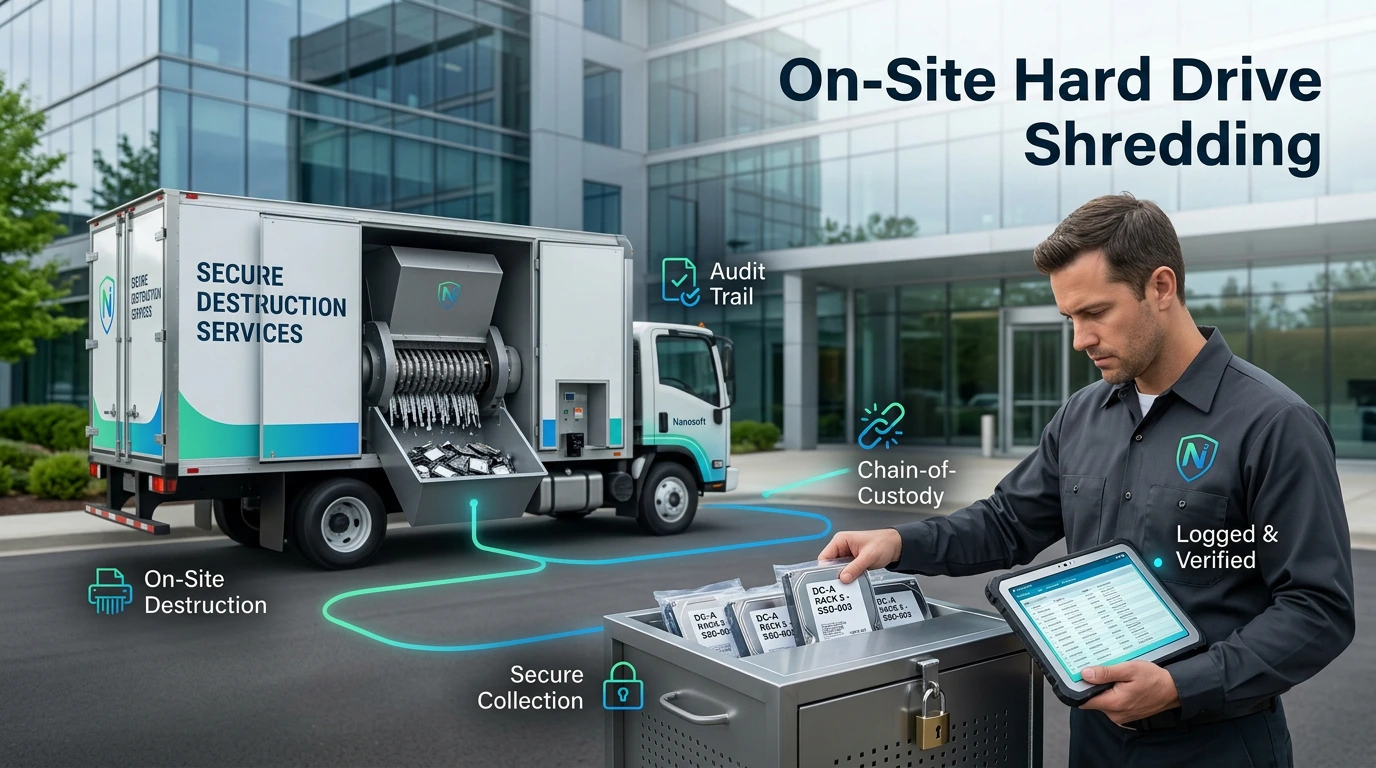
In many cases, off-site processing is perfectly workable when there is a strong chain of custody, secure transport, documented handling, and reliable reporting. However, there are situations where the more appropriate option is on-site hard drive shredding. This allows destruction to take place at the client’s premises, under direct observation, with a clear audit trail from collection to final confirmation.
When on-site destruction makes sense
On-site hard drive shredding is especially relevant when the organisation has a low risk tolerance for data transfer. This is common in sectors such as healthcare, legal services, financial services, defence-related supply chains, public sector environments, and organisations handling large volumes of personal or restricted data.
It is also a strong option during office closures, IT refresh programmes, merger activity, data centre exits, and urgent clearances where old assets must be removed quickly without weakening security controls. For many businesses, the benefit is not just the destruction itself. It is the confidence that the media never leaves the premises intact.
What a professional process should look like
A credible on-site shredding service should be controlled from the start. Devices awaiting destruction should be identified, counted, and handled under supervision. Collection points should be agreed in advance, and access should be restricted so that no device is left unsecured during the process.
The destruction stage should be visible and documented. That may include serial number logging, asset lists, operator records, time-stamped service evidence, and a certificate or destruction report issued after completion. For many organisations, this reporting is just as important as the physical shredding because it supports internal governance, audit readiness, and evidence of secure disposal.
Why visibility matters
One of the biggest advantages of on-site hard drive shredding is transparency. Internal stakeholders, compliance leads, and IT managers can see the process taking place rather than relying entirely on downstream confirmations. That can be particularly valuable where the organisation needs to reassure customers, boards, auditors, or regulators that media destruction was handled in a controlled way.
This visibility also reduces uncertainty during high-pressure projects. If a business is decommissioning infrastructure, clearing an office, or replacing large volumes of end-user devices, a clearly managed on-site process can remove delays and reduce the number of handover points.
On-site does not remove the need for good governance
It is important to remember that on-site shredding is not automatically secure just because it happens at your premises. The surrounding controls still matter. Devices should be tracked before destruction, authorised personnel should oversee the activity, and the business should retain records showing what was destroyed, when, and by whom.
A weak process can still create risk, even if the destruction vehicle is parked outside the building. The organisations that handle this well are the ones that treat media destruction as part of a wider security and asset disposal programme rather than a one-off waste activity.
Final thought
On-site hard drive shredding is not necessary for every disposal project, but for organisations where data exposure risk is a serious concern, it can be the right control. The value lies in immediate destruction, reduced movement of intact media, stronger visibility, and cleaner audit evidence.
Nanosoft supports organisations that need secure, controlled, and professionally documented IT asset disposal. Where on-site destruction is the right fit, the process should protect both the data and the evidence trail around it.
NanoSoft Team
Writer at NanoSoft — covering ITAD, data security, and sustainable technology lifecycle management.
Found this useful? Share it.